A technically clean demoreel is no longer enough to secure an internship in a studio. Since the resumption of junior hiring in 2025, after nearly two years of freeze due to restructuring and uncertainty surrounding generative AI, selection criteria have tightened. Recruiters now filter based on specific signals that most post-baccalaureate programs do not explicitly teach.
3D Production Pipeline: The Technical Filter Recruiters Apply First
A technical director or lead artist opening a demoreel first seeks to verify whether the candidate understands the studio’s pipeline. Modeling a character in ZBrush and then presenting it in a turntable against a gray background does not demonstrate the ability to deliver a usable asset in production.
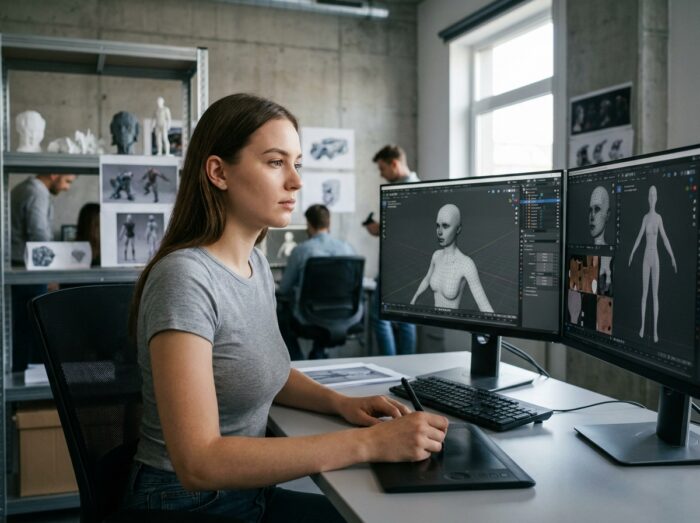
What matters: clean retopology, properly deployed UVs, and consistent PBR texturing. A mesh with several million polygons without retopo proves mastery of sculpting, not an understanding of the workflow. Animation studios running on Maya or Houdini expect assets whose polygon weight remains compatible with the rig and rendering in sequence.
We observe that among 3D programs that lead to animation studios, those that incorporate end-of-year projects under real pipeline conditions (with constraints on naming conventions, versioning, and inter-departmental transitions) produce profiles that are immediately operational in internships.
Schools that only offer software courses without collaborative workflow leave their graduates to discover these requirements once in position, significantly lengthening the adaptation period.
Demoreel After High School: Common Casting Errors and Real Selection Criteria
Generalist recruiters today know how to make an initial selection of 3D portfolios without being artists themselves. According to practices documented by several studios, a portfolio is dismissed in less than thirty seconds if certain warning signals appear.
- Projects that are solely personal, without production context or imposed brief. A recruiter wants to see the ability to respond to an artistic direction, not just to express personal taste.
- The absence of technical breakdowns. A final render that does not show the wireframe, UVs, or compositing passes prevents assessing the candidate’s actual level.
- An overly long demoreel. Beyond two minutes, most leads lose interest. It’s better to have three solid pieces than a montage of eight uneven projects.
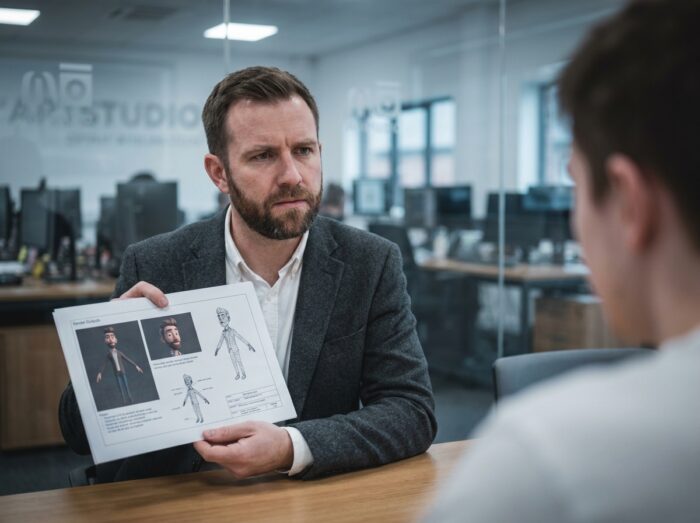
- Isolated assets without context. A character posed in T-pose says nothing about understanding movement or integration into a setting.
Post-high school programs that effectively prepare for this filter impose end-of-semester renders with a simulated client brief, deadline constraints, and presentations before a jury including active professionals.
Degree Recognition and Registration with the RNCP: What the Market Truly Values
The 3D animation sector in France remains structured around private schools, whose quality varies significantly. A degree registered with the RNCP does not guarantee pedagogical quality, but its absence complicates access to apprenticeships and public funding.
On Parcoursup, programs in art and digital design rarely display their studio insertion rates. We recommend checking three indicators before committing to a program:
- The list of partner studios for mandatory internships. An active partnership with organizations like Illumination Mac Guff, Mikros Animation, or TeamTO carries more weight than a generic label.
- The ratio of practitioners to academic teachers. A program where most instructors work concurrently in studios conveys up-to-date practices.
- Publicly visible end-of-study projects. If the school does not showcase the promotional films of its students, it is a weak but significant signal.
Schools like ArtFX, Supinfocom (Rubika), ESMA, or Gobelins remain the historical references in the French market. Their common point: a high volume of student production, with short films regularly selected in festivals like Annecy or Siggraph.
Apprenticeship in Animation Studio: An Accelerator Under Conditions
Apprenticeships in this sector are less common than in web development or digital marketing. Studios operate on a project basis, with workload peaks difficult to plan around the school-business rhythm. Apprenticeship positions mainly exist in motion design and post-production, less so in character animation or layout.
A student who secures an apprenticeship in a studio gains a decisive advantage: they accumulate credits on broadcasted productions, which gives their demoreel a legitimacy that school projects alone do not provide.
3D Job Market in 2025-2026: Confirmed Recovery but Increased Selectivity
The Visual Effects & Animation World Atlas 2026 by Joseph Bell indicates a global workforce growth of 2.7% over the last twelve months, compared to 1% the previous year, across more than 140,000 professionals and 2,900 tracked companies. The recovery is real, but it does not uniformly benefit juniors.
Studios that are hiring again target profiles capable of quickly integrating into an existing pipeline. The freeze phase in 2023-2024 created a bottleneck of graduating classes that did not find their first position. Competition among recent graduates is therefore stronger than before the crisis, even though the overall volume of positions is on the rise.
Paris concentrates a significant share of opportunities in France, but hubs like Angoulême, Lyon, and Montpellier are gaining strength due to the establishment of studios specializing in series and video games.
The criterion that makes the difference at this stage of the market is neither the name of the school nor the duration of the program. It is the ability to demonstrate, from the very first interview, that one can deliver an asset that meets the standards of a production pipeline, on time, with clear communication about the technical choices made.