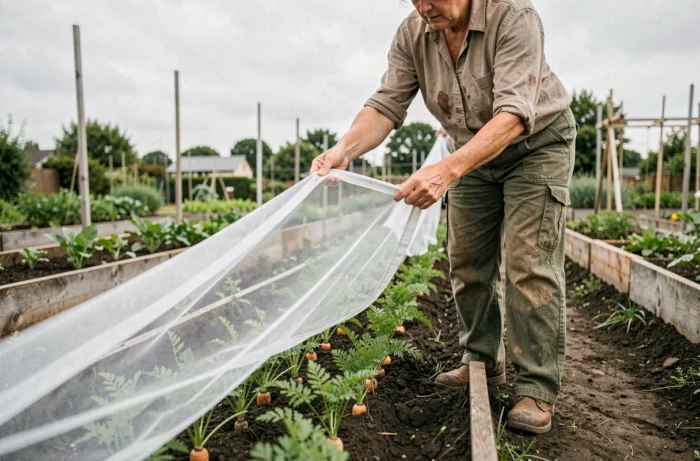
Your anti-fly net has been in place since sowing, and the carrots are growing quietly underneath. But when should it be removed, and above all, is it always a good idea? Removing the net at the wrong time can ruin weeks of protection against the carrot fly. Understanding the pest cycle and the state of your plot changes everything.
Carrot fly under the net: when protection turns against you
Have you ever noticed brown galleries in carrots grown under a net? This frustrating scenario can be explained by a detail that many gardeners underestimate. The net blocks adult flies coming from outside. However, it does not neutralize the pupae already present in the soil.
Specifically, if you grow carrots in the same spot for two consecutive years, Psila rosae pupae can overwinter in the soil. In spring, the adults emerge directly under the net. They lay eggs at the base of the plants, and the net even prevents their natural predators from intervening. The protection then becomes a trap.
This is why crop rotation determines the effectiveness of the net. Without annual movement of the carrots, covering the bed is not enough. Before placing or removing your net, check the history of the plot. A bed that has grown carrots, parsley, parsnips, or celery the previous year poses a real risk, even under protection.
The first step to combat the carrot fly is therefore a careful reading of your own soil before relying on a simple cover.
Fly flight period and net removal schedule
The carrot fly does not fly all year round. It has two distinct generations, and it is this double cycle that traps most gardeners.
The first generation flies in spring, usually when temperatures stabilize. Females lay eggs at the base of young plants. The larvae develop in the roots and then pupate in the soil.
A second generation appears in late summer and can remain active until autumn. It is this second wave that many forget. Removing the net after the summer harvest, thinking the danger has passed, exposes the carrots left in the ground.
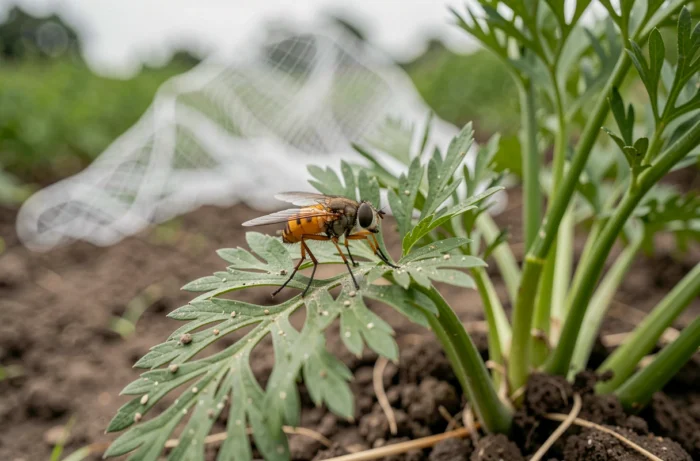
Why is this timing so important? Because the dates vary by region and the weather conditions of the year. There is no universal calendar. The reliable rule is: only remove the net after the confirmed end of the last flight, not after your first harvest.
To spot flight periods, some gardeners use sticky yellow chromatic traps placed near the rows. As long as adult flies are being captured, the net should remain in place.
Removing the anti-insect net in the vegetable garden: actions that limit risk
Even in the middle of the season, it is sometimes necessary to lift the net. Weeding, thinning, watering: these interventions create a window of access for adult flies. The recommended field method is simple but demanding.
- Lift only one edge of the net at a time, never the entire surface. Flies quickly spot openings and lay eggs within minutes.
- Intervene early in the morning or late in the day when flying activity is lower.
- Close immediately after each intervention, even if you need to return ten minutes later to finish the row.
- Ensure that the edges of the cover remain well pressed to the ground, with no free passage. A poorly secured net loses most of its effectiveness.
The final removal of the net should only occur in two cases: the complete harvest of the bed, or the certainty that the last flight is over in your area. When in doubt, it is better to leave the cover on for an extra week than to remove it a day too early.
Anti-fly net and microclimate: a side effect to watch
The net does not just block insects. It also alters the conditions under the cover. Temperature and humidity increase, especially in summer. This microclimate promotes leaf growth, but it can also encourage the development of fungal diseases if ventilation is insufficient.
A net left too long on moist soil creates an environment conducive to rotting. Paradoxically, removing the cover at the right time also protects the quality of the roots in terms of health, beyond the issue of flies.
Choosing a cover with an appropriate mesh helps limit this problem. Fine mesh nets block carrot flies (whose adult size is around four to five millimeters), but very tight meshes also reduce air circulation. There is a compromise between protection against the pest and sufficient aeration for the plants.
Rotation, sowing, and carrot varieties: complements to the net
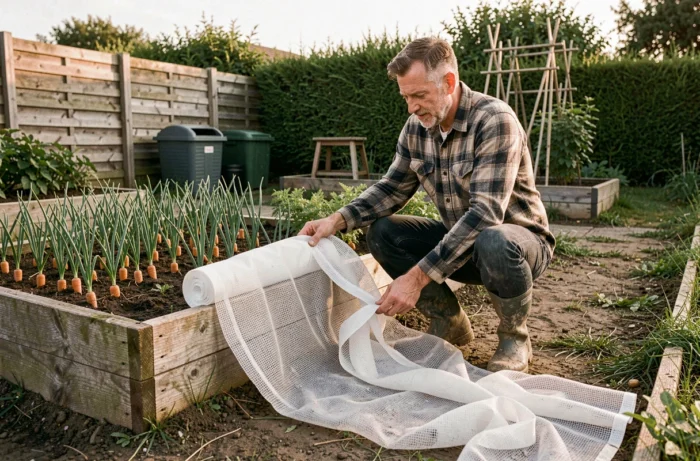
The net alone does not constitute a complete strategy. Three complementary levers enhance its protection.
- Crop rotation remains the most effective measure to break the pest cycle. Never replant carrots or other Apiaceae (parsley, parsnips, celery) in the same bed for at least two years.
- Some carrot varieties have lower sensitivity to the fly. Choosing varieties, combined with sowing that avoids peak flight periods, significantly reduces pressure.
- Strong-smelling plants, such as onions or leeks, planted at the edge of the row, can help disorient females searching for laying sites.
None of these measures replace the net during periods of active flight. They complement the physical barrier and help limit the use of chemical treatments in the vegetable garden.
The right reflex, ultimately, can be summed up in one sentence: the net is removed when the last flight is over and the harvest is planned, not before. Observe, trap, check the plot history, then decide. It is this patience that makes the difference between a healthy harvest and gallery-infested carrots.