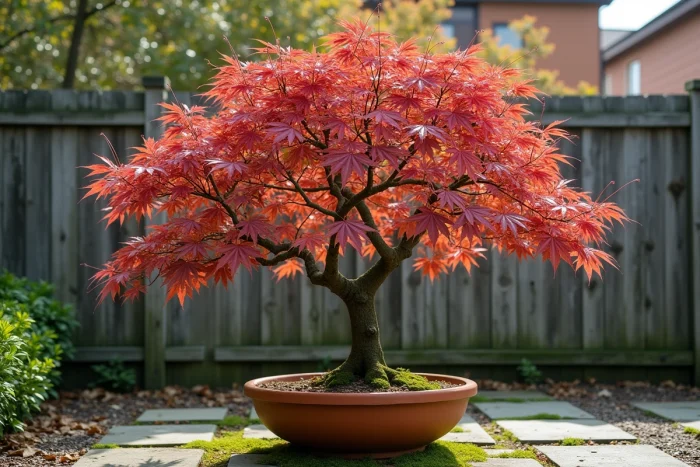
The Japanese maple (Acer palmatum) naturally sheds its leaves every autumn. However, when leaf drop occurs in the middle of summer, or when the foliage dries out abruptly without prior coloration, the problem lies elsewhere. Water stress, unsuitable soil, fungal disease, or poorly calibrated exposure: the causes often accumulate, and diagnosis requires reasoning by elimination.
Japanese maple in peri-urban environments: the heat effect amplified by urbanization
Field reports vary on this point, but a trend is emerging: Japanese maples planted in peri-urban areas suffer more than those installed in the countryside. The reason lies in urban heat islands. Concrete walls, patios, masonry fences, and dark surfaces store daytime heat and release it at night.
For an Acer palmatum, this residual nighttime heat prevents the recovery of leaf tissues. The stomata, which should reopen at the end of the day to compensate for evapotranspiration, remain partially closed. The foliage dries out from the edges and then falls prematurely.
Some architectural adaptations in the garden can mitigate this effect. Planting the maple near a north or east-facing wall provides shade during the hottest hours. A soil covered with light gravel or thick organic mulch reduces reflection and maintains root coolness. Understanding why the Japanese maple loses its leaves also involves analyzing its immediate environment, not just observing the tree itself.
Dwarf varieties like ‘Shaina’ show greater resilience to leaf loss in continental climates compared to traditional weeping forms, due to better adaptation to dry spring winds.
Soil and watering of the Japanese maple: two common mistakes that cause leaf drop
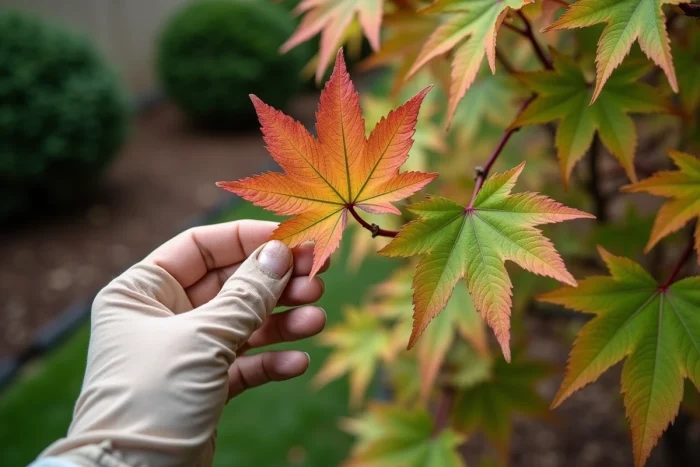
The Acer palmatum requires acidic, cool, and well-drained soil. Calcareous or compact soil suffocates the fine roots, and the first signs appear on the foliage: interveinal yellowing, followed by sudden drying.
The most common trap concerns watering. Excess stagnant water causes exactly the same symptoms as a lack of water. In both cases, the leaves dry out and fall. The distinction is made by touch: a waterlogged soil remains sticky at depth, while dry soil crumbles to dust within the first few centimeters.
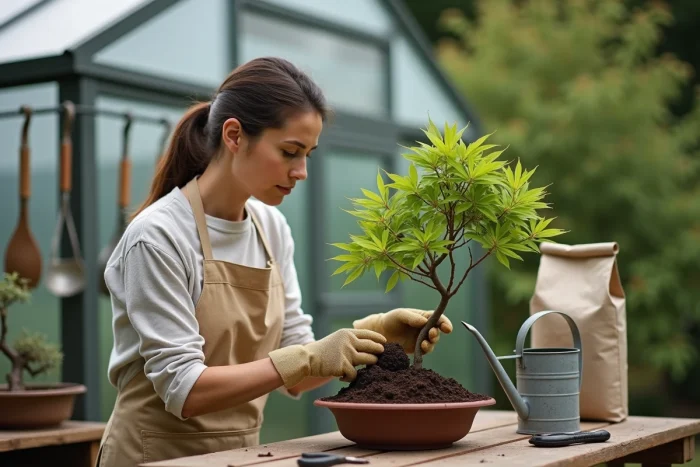
Correcting the substrate of a potted maple
In a pot, the problem worsens. The limited volume of soil heats up faster, dries out quicker, and drainage depends entirely on the container. A black plastic pot placed on a south-facing terrace can reach temperatures that burn the fine roots.
- Prefer a large-diameter terracotta pot, which better regulates the temperature and humidity of the substrate
- Use a mix of heather soil, compost, and pumice to ensure both acidity and drainage
- Elevate the pot on wedges to prevent any water stagnation at the drainage hole
A potted maple requires regular but moderate watering, ideally in the morning, so that the substrate does not remain saturated overnight.
Verticillium wilt of the maple: recognizing this disease before it spreads
Verticillium wilt is the most destructive fungal disease for Acer palmatum. The fungus Verticillium dahliae colonizes the sap-conducting vessels and blocks the water supply to entire branches. The characteristic symptom: one or more branches lose their leaves suddenly, often on one side of the tree, without the rest of the foliage being affected.
By cutting the affected branch at an angle, one observes a browning of the vessels in a ring under the bark. This dark ring confirms the diagnosis.
Limiting the spread of verticillium wilt
There is no approved curative treatment against Verticillium. Management relies on prevention and limiting damage.
- Immediately remove affected branches by cutting at least twenty centimeters below the browned area, using a disinfected tool
- Do not compost diseased wood: burn it or dispose of it at a waste facility to avoid soil contamination
- Avoid replanting a maple in the same location, as the fungus survives for several years in the soil
- Improve soil drainage and reduce nitrogen input, as excess nitrogen fertilization promotes the progression of the fungus
The available data does not allow for conclusions on the effectiveness of mycorrhizae as a preventive barrier, although some nurserymen report encouraging results on young plants.
Exposure and wind: adapting the location according to the variety of maple
The Japanese maple does not tolerate prolonged direct sunlight and drying winds well. Varieties with finely dissected foliage, such as dissectum, are the most vulnerable. Their finely laciniated leaf surface increases evapotranspiration and makes them sensitive to hot wind gusts.
Partial shade exposure, with morning sun and afternoon shade, constitutes the safest compromise. However, permanent total shade weakens leaf coloration and makes the tree more susceptible to fungal diseases due to excess ambient moisture.
Wind poses a distinct problem. In exposed areas, a vegetative windbreak (evergreen hedge, bamboo) placed a few meters away reduces flow speed without creating turbulence. Protecting the maple from wind reduces leaf desiccation as much as watering.
For peri-urban gardens where space is limited, compact varieties tolerate constrained conditions better. An Acer palmatum ‘Shaina’ or a ‘Little Princess’ occupies less volume, requires less setback from walls, and withstands climatic shocks better than larger sprawling cultivars.
When a Japanese maple loses its leaves outside of autumn, the cause is rarely singular. Soil, water, exposure, disease, and microclimate interact. The most reliable diagnosis begins with the soil and watering, moves through examining the branches to rule out verticillium wilt, and ends with an honest assessment of the location. Moving a poorly situated maple often remains the most effective solution, provided it is done during the dormant period.