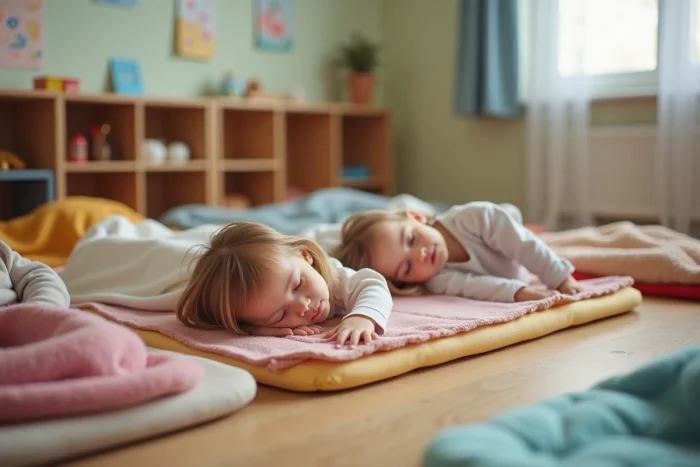
Your child is entering preschool and you are wondering how naptime works at school. Between what the educational framework states and what actually happens in the classrooms, parents often lack clear guidelines. Naptime in preschool meets a physiological need of young children, but its organization varies from one school to another, and certain situations need to be anticipated.
Mandatory wake-up in class: what to do when the school cuts naptime too early
You may have already experienced this situation: your child comes home from school grumpy and tired because they were woken up after a short nap to resume class activities. This scenario is common, especially in the middle section.
Recent educational documents emphasize one specific point: wake-up should be gradual and staggered, never collective and abrupt. A child awakened in the middle of a sleep cycle accumulates a fatigue debt that disrupts their end of the day and sometimes even their following night.
If your child’s school practices a group wake-up at a fixed time, you can request a meeting with the teacher to discuss the issue. The institutional framework is on your side: the nap for children aged two to four takes precedence over other class activities, except in exceptional cases. Calmly restate this rule without confrontation, suggesting, for example, that your child joins the group as soon as they wake up naturally.
To better understand the regulatory framework, particularly the mandatory nap in the small section on Carnet de Bébé, it is useful to know the texts that govern the organization of school time for the youngest.
In practice, note your child’s bedtime and wake-up time at home for one or two weeks. These concrete data support your request to the educational team much better than a general feeling.
Naptime in preschool: mandatory rest or simple recommendation
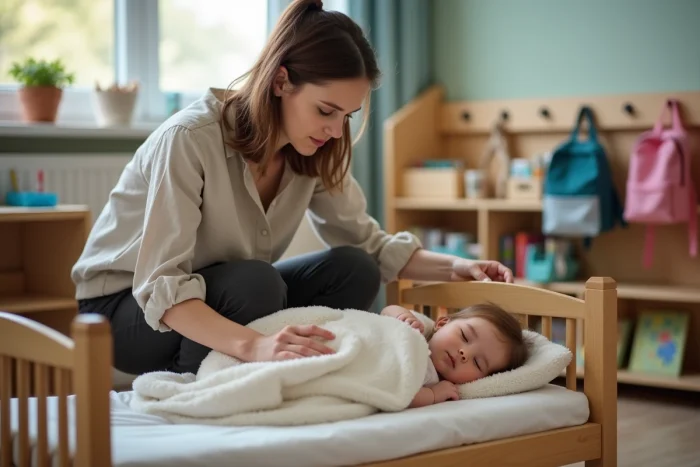
Confusion is common. Naptime is not a legal obligation for all preschool students. The school must offer a rest period appropriate to the age and needs of each child, with increased attention in the small section.
In the small section, the ministry has established a specific framework. The obligation of attendance can be adjusted to take into account the sleep needs of the youngest. In practice, a child in the small section may be absent in the afternoon if their parents request it and if the school approves this arrangement.
Starting from the middle section, the situation changes. Naptime is no longer systematically offered. Some children still need it, while others do not. The focus then shifts to the balance between the child’s individual rhythm and the collective organization of the class.
Quiet time for non-sleepers
Field recommendations increasingly emphasize a point that parents are often unaware of: a child who does not sleep after twenty minutes should be allowed to get up. They then benefit from a quiet time before joining suitable activities.
Forcing a child to stay lying down without sleeping for more than an hour has no educational or physiological benefit. If your child reports that they lie down for a long time without falling asleep, it is a signal to communicate to the teacher.
Duration of naptime in preschool and sleep rhythm according to age
The daily sleep time for a child between two and five years old varies from twelve to fourteen hours on average. Naptime represents a variable portion of this total, and it evolves quickly from one school year to the next.
- In the small section (two to three years), most children need a nap right after lunch. A sleep cycle lasts between one and a half to two hours, which corresponds to the recommended duration for feeling rested.
- In the middle section (four years), the need for naptime decreases for many children. Some naturally transition to a simple quiet time. Others still sleep for an hour or more.
- In the large section (five years), naptime disappears for most children. Sleep consolidates overnight. A quiet time after lunch remains beneficial.
Each child follows their own rhythm. A child in the middle section who still sleeps for a long time during naptime is not lagging behind: their brain, still maturing, simply needs more recovery.
Preparing for naptime at school: practical tips for parents
The naptime environment at school differs from that at home. Your child sleeps in a shared room, with residual noise and bedding different from their bed. A few adjustments at home can facilitate this transition.
What you can do before the start of the school year
- Get your child used to falling asleep without rocking or continuous presence. At school, the ATSEM or teacher cannot stay with each child individually.
- Choose a unique, identifiable comfort object that will remain in the school bag. A familiar comfort object is the most effective emotional anchor for securing sleep in a group setting.
- Maintain a stable bedtime routine at home: same time, same actions. This regularity helps the child recognize sleep signals, even in a different environment.
Communicating with the educational team
If your child has specific sleep characteristics (late falling asleep, night terrors, frequent awakenings), share this information at the beginning of the school year. The teacher and ATSEM can adapt their support when they have these reference points.
A discussion at the beginning of the year is better than an alert during the term. Do not wait for fatigue to accumulate to signal a difficulty.
The organization of naptime in preschool relies on a balance between collective framework and individual needs. The texts provide for flexibility, but this is only activated if parents communicate with the team. Keeping an eye on your child’s signs of fatigue, noting their sleep times, and maintaining contact with the school remains the best way to navigate these early years of schooling smoothly.