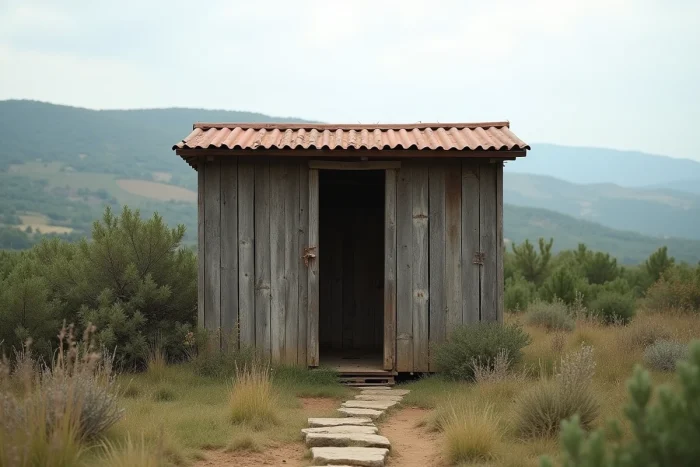
A shed listed on the cadastral plan on a parcel classified as non-buildable does not confer any right to build or change the use of the structure. The confusion between cadastral registration and urban planning authorization remains the most frequent trap during an acquisition. We regularly observe buyers convinced that the mention in the cadastre equates to regularization, whereas only the zoning of the PLU or PLUi determines what is permitted on the parcel.
Requalification of use and risk of demolition: the trap of the shed on stilts
A shed presented as removable or reversible (wooden structure on stilts, absence of concrete foundations) does not escape the scrutiny of the administrative judge. Jurisprudence retains a simple criterion: durable implantation and actual use take precedence over construction technique. A stilted structure used as a living space, even seasonally, can be requalified as a fixed construction.
This requalification leads to two direct consequences. The first is the obligation to submit a building permit application or a prior declaration, a request destined for refusal in non-buildable areas. The second is the risk of a violation report under the Urban Planning Code, followed by an injunction to restore the site, meaning demolition.
We recommend systematically checking whether the cadastral shed on non-buildable land has a building permit or an archived prior declaration at the town hall. The absence of these documents considerably weakens the owner’s position in case of inspection.
PLU zoning and easements: why the cadastre says nothing about your rights
The cadastre is a fiscal tool. It lists parcels and buildings to calculate property tax and housing tax. It neither validates the legality of a construction nor its authorized use. Only the applicable urban planning document (PLU, PLUi, municipal map) sets the rules.
On a parcel classified in zone N (natural) or A (agricultural), the zoning regulations prohibit most new constructions and limit work on existing structures to regular maintenance. An extension, elevation, or change of use to residential requires a modification of the zoning, a lengthy procedure that falls under the municipal council and not the owner.
Easements that block any project
Beyond zoning, specific easements can render a cadastral shed completely unusable:
- A classified wooded area (EBC) requires the conservation of woodlands. Any construction compromising this objective is refused, even if the land is not strictly classified as zone N.
- A utility easement (water, electricity, gas) may prohibit any ground occupation within a defined perimeter around the pipeline.
- A protection perimeter for a historical monument or a drinking water catchment adds additional constraints that apply to the PLU itself.
The overlap of these easements with zoning creates situations where a shed perfectly visible in the cadastre cannot be expanded, renovated beyond strict maintenance, or inhabited.
Authorized work on a shed in a non-buildable area
The scope of action is limited to maintenance and identical repairs. Replacing a damaged roof with the same material, redoing a coating, changing a window to existing dimensions: these interventions generally do not require authorization if they do not alter the exterior appearance or ground footprint.
Any modification that increases the floor area or changes the use of the building falls under the scope of a building permit or prior declaration. In non-buildable areas, these requests are refused in almost all cases.
The specific case of annexes and garden sheds
Installing a garden shed, even of small size, on non-buildable land remains subject to urban planning law. The temptation to place a lightweight structure without declaration exposes the owner to the same penalties as for a solid construction. The town hall has a six-year prescription period from the completion of the work to initiate proceedings, and this period only runs if the work is actually completed and visible.
Buying non-buildable land with a shed: checks before signing
The notary queries the town hall’s urban planning department to obtain the urban planning certificate (CU) for the parcel. This document details the zoning, easements, and applicable rights. We observe that some sellers present the cadastral registration as a guarantee of regularity, which is legally inaccurate.
Before signing a preliminary agreement, three checks are necessary:
- Request a operational urban planning certificate (CUb) that specifies whether a given project is feasible on the parcel, not just a simple informative CUa.
- Consult the zoning regulations of the PLU for the relevant parcel, available at the town hall or on the urban planning geoportal.
- Investigate the existence of a building permit or prior declaration for the shed in the municipal archives. The absence of an urban planning title means that the building may be considered irregular.
The market value of non-buildable land with a shed remains significantly lower than that of buildable land. An attractive price precisely reflects the usage restrictions, not a hidden opportunity. The buyer who hopes for a future reclassification to buildable land is betting on a municipal political decision with no guarantee of timing or outcome.
The cadastral shed on non-buildable land remains a property subject to property tax on built properties, regardless of the legality of the construction. The tax burden exists, and usage rights remain limited to the strict framework of zoning. Any strategy based solely on the cadastre to justify a housing or extension project faces the Urban Planning Code, and the administrative judge consistently rules in favor of the zoning rule.