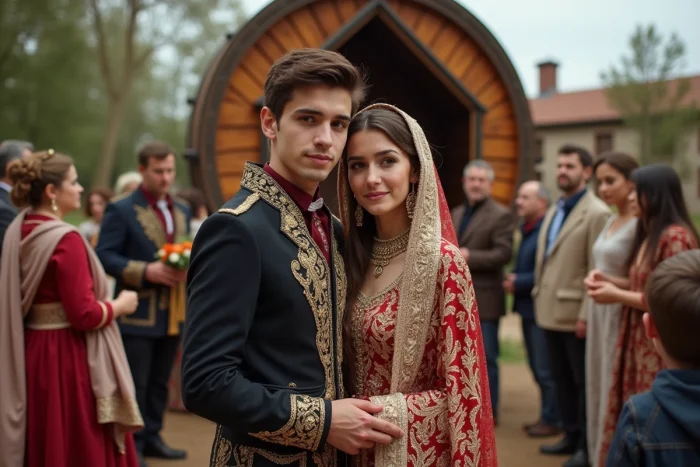
A marriage celebrated according to Gypsy rites in France does not confer any rights before the civil registry. Yet, families continue to prioritize these unions, whether recognized by law or not. French law requires a mandatory visit to the town hall for a marriage to be official, but this formality is often set aside, relegated to the background by many members of the community. Formalizing a bond without an official act can complicate parentage or inheritance, but for many, the strength of custom outweighs recognition by institutions.
Gypsy customs in France: between heritage and vibrancy
Often reduced to a folkloric backdrop in the collective imagination, Gypsy customs in France are, however, woven into the fabric of daily life, where each clan defends its identity and landmarks. In Perpignan, Marseille, Paris, family remains central. Alliances are formed among Manouches, Sintis, or Kalderash, sometimes away from official institutions but never without flair.
In these marriages, everything begins with the words of the elders: they organize, negotiate, and validate each step, from choosing the partner to the smallest detail of the ceremony. It is much more than a sentimental affair: the union connects two families, and each ritual is a link to past generations.
Some practices take on a new look, while others persist unwaveringly. A few examples illustrate this evolution:
- Rituals like the famous handkerchief ceremony are today rethought or abandoned by the youth, proving that tradition does not merely repeat itself but adjusts.
Transmitting this heritage does not solely occur through ceremonies. It is a source of pride, belonging to a people whose codes endure, even if national legislation hardly acknowledges them. These customs forge a solid foundation for those who share them, despite their lack of institutional recognition.
Between a desire for openness and a fierce attachment to roots, the community negotiates its space. Debates on the value of customary marriage and adaptations to the global society reflect this movement: maintaining one’s course without completely turning away from the rest of the world.
How does a Gypsy wedding unfold? Rituals and key moments
Gypsy weddings are always written in the plural: no celebration resembles the previous one, but all rely on significant moments. Before the ceremony, the engagement, or Plotchka, already seals bonds between two families.
Among the elements that mark these rituals, several objects carry strong symbolism:
- The passing of a bottle of wine or brandy, an embroidered handkerchief, gold coins: each gesture inscribes the future bride into the groom’s kinship, in view of all.
The handkerchief ceremony, called Panuelo, led by a respected matriarch, holds a special status. This ritual, centered on the bride’s purity, is now divisive. In some clans, the tradition is wavering, a sign that Gypsy society is also transforming. But beyond that, it is the strength of the union of families that prevails.
The exchange of gifts takes on its full meaning: jewelry passed down through generations, traditional clothing, objects rich in history… all tangible signs that seal the family pact.
The celebration, for its part, breaks down divisions. Music, singing, communal meals vibrate throughout the gathering until the end of the night. Groups like Tekameli or Chico & the Gypsies are sometimes invited to heighten the intensity of the evening. Here, oral culture is transmitted on the dance floor as much as at the table.
Generations mingle, each rediscovering, with each union, the joy of bringing these traditions to life vocally and with broad gestures. Belonging is not written; it is sung and celebrated.
Recognition of Gypsy marriage: what is its fate under French law?
The customary Gypsy union, contracted according to the codes specific to each family, holds no weight before the civil code. Only an official visit to the town hall grants legal existence to the marriage and allows access to the social or inheritance rights that the Republic opens the door to.
The religious ceremony, often central to the celebration, carries powerful symbolic weight but has no effect on the couple’s legal status. French courts, up to the Court of Cassation, regularly remind of this rule: only civil union counts for the State.
Neither customary marriage nor religious union, however respected within the community, can replace the civil act. National law, based on secularism, imposes its own frameworks on family life.
The civil procedure thus retains its place, even if the Gypsy community holds on to its customs. Even protected by the European Convention on Human Rights, personal convictions do not allow for bypassing the act at the town hall.
On the ground, families and couples navigate between grand festive masses, respect for elders, and administrative roadmaps. The celebration, however, withstands everything: songs, reunions, and the sense of community defy the institutional calendar and reaffirm, marriage after marriage, a collective identity with proud contours. In the margins of the law, Gypsy tradition continues, untamed and reinvented, its red thread firmly tying into the heart of each union.