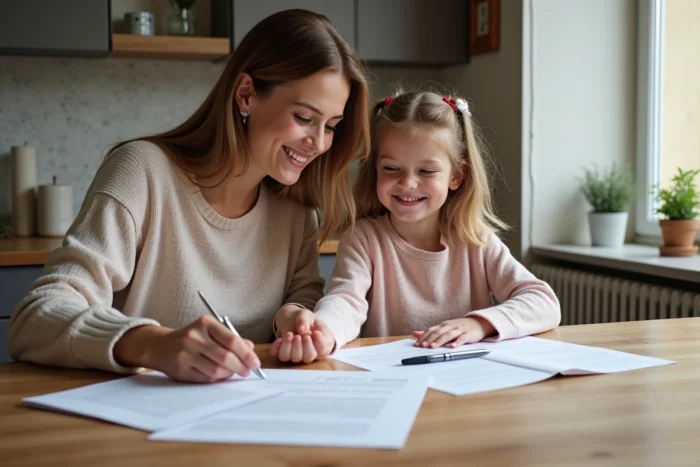
A married or civil partnership couple does not benefit from any privileges: adopting their partner’s child means going through the scrutiny of the law and concrete evidence. Here, nothing is left to approximation. To qualify for adoption, one must prove the stability of the relationship, obtain the consent of the biological parent, and provide a series of impeccable documents. Between simple adoption and full adoption, each choice profoundly reshapes the family landscape. The former maintains certain ties to the origin, while the latter completely dissolves them to reconstruct the lineage. In both cases, there is no question of navigating blindly: every piece of the file is valid, and each step marks a turning point for the child’s future.
Understanding the two forms of adoption: full adoption and simple adoption
Take the time to decipher the distinctions before embarking on the adoption procedure for the partner’s child. Full adoption changes everything fundamentally: the child officially cuts ties with their biological family, sees their civil status modified, and their last name possibly replaced. Simple adoption, on the other hand, preserves a part of the origin story and maintains some rights with the biological family. This point reassures many blended families determined to strengthen new bonds without erasing the past.
Conditions to meet and steps to follow to adopt the partner’s child
Do not think that the process is limited to two signatures and a few papers on the corner of the table. Each step requires unwavering seriousness, a meticulously assembled file, and total transparency. To initiate this process, the following elements must be gathered:
- Prove the solidity of the couple, whether it is a marriage, a civil partnership, or cohabitation authenticated by supporting documents (lease, official letters, joint tax notices, etc.)
- The child in question must be a minor: beyond the age of majority, only an exceptional situation can allow it.
- Submit the written consent of the parent not initiating the request, unless there is death or deprivation of parental authority pronounced by the judge.
- If the child is 13 years old or older, their written consent for the adoption is mandatory.
Once this puzzle of documents is gathered, civil status extracts, certificates of cohabitation, agreements, and consents, head to the judicial court. The judge may order a social investigation to ensure that everything is in order and that the child’s best interest prevails. The goal: to secure an existing family reality, not to point fingers or destabilize the household.
When the adoption is validated, the child’s birth certificate undergoes significant modifications. Their name may change, parental authority is shared equally, and the rules regarding inheritance and rights evolve, aligning the adopted child on the same level as the couple’s other children.

Legal consequences and concrete effects: what adopting the partner’s child changes
Adopting one’s spouse’s child goes far beyond a simple emotional or administrative act. In the case of full adoption, the link with the biological family, outside the couple, disappears permanently. The child then has exactly the same rights and duties as if they were born to the couple: civil status corrected, nationality, inheritance, everything shifts to this new family foundation.
In daily life, these consequences manifest very concretely:
- Upon request and if the judge deems it justified, the child’s first name can also be changed.
- With simple adoption, the child retains ties with their biological family and the possibility of appearing on a double inheritance line.
- Full adoption by a French parent automatically results in the acquisition of French nationality for the adopted child.
The family record book is updated, parental authority effectively becomes shared, and inheritance follows the same rules for all children in the household. Adoption definitively closes any uncertainty: the child fully integrates into this new family, with recognition and security before the law.
Carrying out this procedure offers the child a double strength: that of emotional ties, sealed once and for all by the power of law. It is also about writing, together, the family history on unshakeable foundations.